Those who stand still lose.
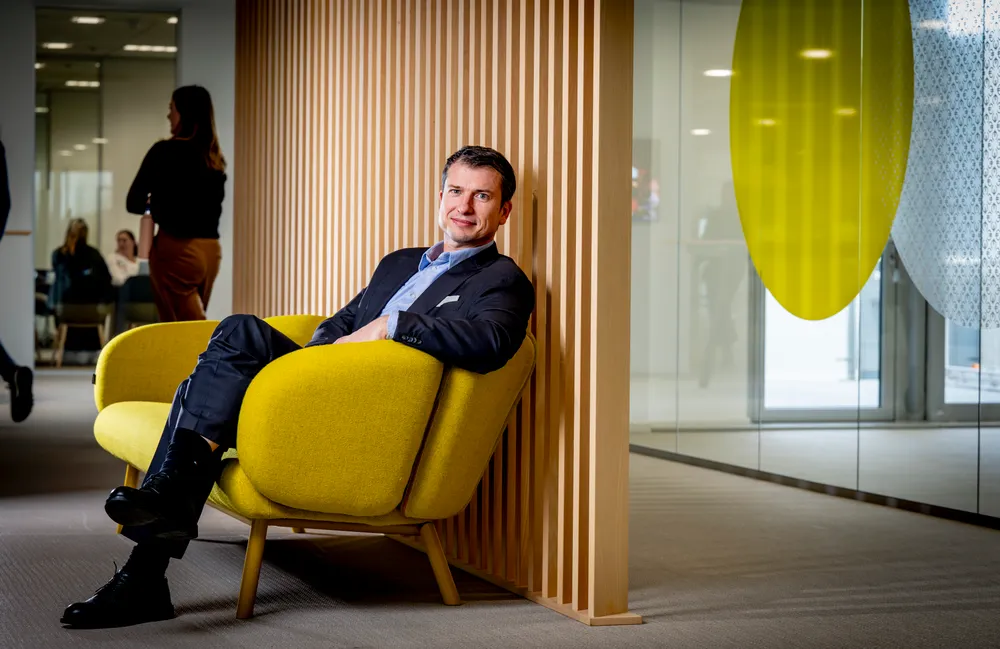
Jeroen van Glabbeek
CM.com
CM.com operates worldwide in communication and payment technology. From fifteen countries, more than 700 people work on solutions for businesses and consumers. Founder and CEO Jeroen van Glabbeek talks about the impact of AI, the definition of innovation and the challenge facing Breda.
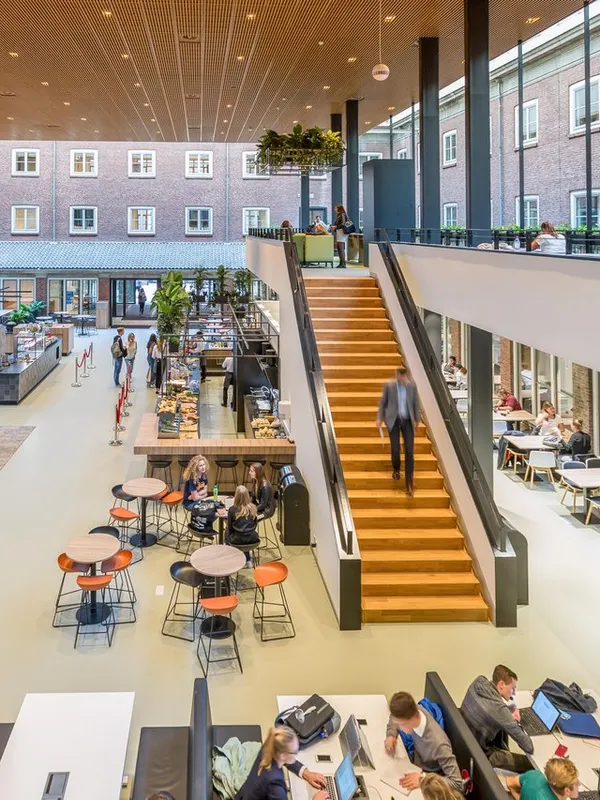
Anyone visiting the CM campus in Breda can see an ecosystem taking shape. Each of the seven buildings has its own specialisation. The outdoor space will soon become greener, there is a gym next door, and with ’t Zoet as its neighbouring area, an innovation link to the city centre will soon be in place. “We’ve been in this city for 26 years,” says Jeroen van Glabbeek, co-founder and CEO of CM.com. “My business partner and I entered a business plan competition. Our submission: sending text messages to promote nightclubs; we called it Club Message. We received a low score, but the idea proved to be worth its weight in gold. We now process around eight billion messages a year: we are globally number three in WhatsApp traffic and number six in SMS.”
Innovation = speed
The world of CM.com revolves around speed. And that speed, says Van Glabbeek, is precisely what innovation is all about. “AI is a complete reset for science. Knowledge is available everywhere at the same time – what we read in Breda, they also read in China or the US. In that respect, we are not lagging behind; we have the same access. The question is: how quickly can you apply it?”
For him, that is the essence of the Innovation District: “Innovation is about moving quickly and experimenting. In research, something may take five years; in technology, five weeks is already a long time. The difference between winning and losing comes down to speed. That is what the district must make possible: direct access to labs, knowledge, people and facilities. If a company wants to test something tomorrow, it should be able to do so tomorrow.”
Where will autonomous cars and medical robots break through? In the municipality that allows them to be tested.
Jeroen van Glabbeek
Willingness to fail as a prerequisite
Van Glabbeek emphasises that an innovation district cannot simply be created to order. “You can’t draw it on a map and say: this is where innovation happens. It has to emerge. And that only works if the culture is right. A willingness to fail is part of that. More goes wrong than right, but that’s how you learn. That requires something of politicians, because making mistakes isn’t popular. Yet it’s essential. Where will autonomous drones and cars, or medical robots, make their breakthrough? In the municipality that allows them to be tested.”
To achieve that speed, the barriers must be lowered. “Everything that takes time in a business – finding staff, securing finance, obtaining permits – must be removed. Entrepreneurs must be able to focus on what really matters: developing technology. That requires support, creating conditions that increase the chances of success. And a network in which people know how to find one another. Because innovation is ultimately about people. AI, robotics and the cloud accelerate everything, but it is people who give innovation meaning.”
In this, he sees a role for the district: “We often look too far afield for collaboration or talent. It’s not in our system to consider that the best people might be right here around the corner. The Innovation District can help strengthen those short lines, within Brabant, the Benelux and Europe. A strong local chain makes us stronger internationally.”
Remain relevant as a city
According to Van Glabbeek, Breda’s choice of Applied Technology and Creativity (TT&C) is exactly right. “‘Applied’ makes all the difference. Here, technology is not merely conceived, but put to immediate use. That is where value is created. We do that too: from QR codes on collection tins to mobile payments – digital solutions that help people move forward in practice. AI and robotics will increasingly become part of this, in product development, customer service and even creative processes.” His message aligns with the challenge of remaining relevant as a city and region. “Those who stand still lose out. That applies to cities just as much as to companies. Breda now has the opportunity to join that acceleration. The Innovation District is the flywheel driving it.”
Success Moments
According to Van Glabbeek, that development calls for a different way of thinking. “We often plan now as though everything has to be completed by a certain number of years from now. But innovation does not work on a single timeline. You need moments of success in the short, medium and long term. A first building, a first resident, a first breakthrough. Those visible steps generate energy.”
And at least as important: pride. “Ambition is great, but you also have to show it. Share what works, bring people along. I’d love it if, before long, coachloads of people came to Breda to see what’s happening here. Tours, showcases, an experience – show that it can be done.”